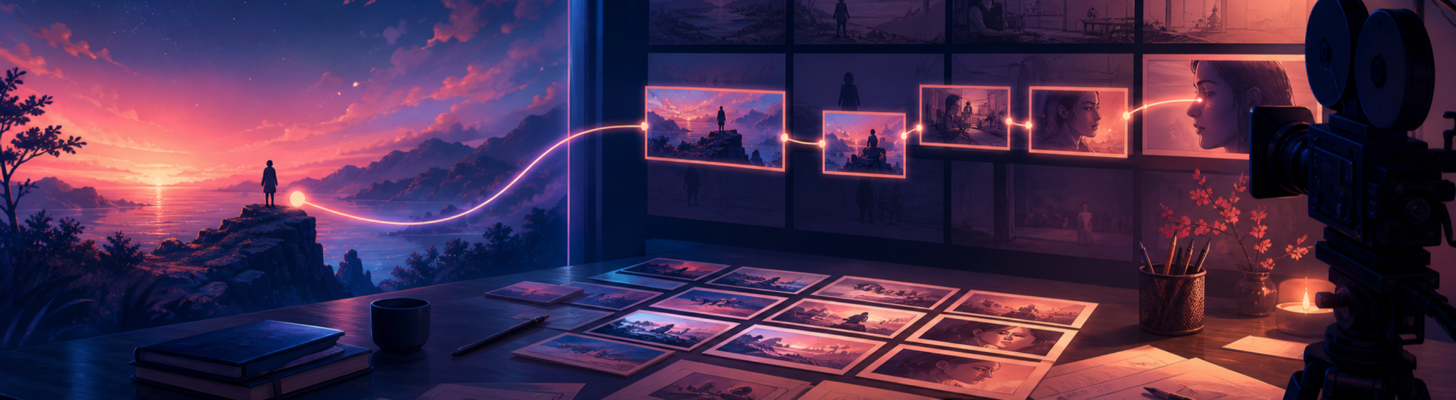
A shot list should not begin with “make it cinematic.” It begins with a scene objective: what does a character want, what resists them, and what changes by the end?
Write a One-Paragraph Scene Brief
Before choosing a camera angle, define:
- the location and relevant world facts;
- the character’s immediate objective;
- the obstacle or opposing objective;
- the moment of change; and
- the audience feeling you want to leave behind.
This brief gives every shot a job. It also creates a precise context packet if you use AI to explore visual options.
Break the Scene into Beats
List the moments where knowledge, power or emotion changes. A negotiation might move from confidence, to discovery, to an attempted bluff, to exposure. Those are beats. The scene is the larger unit; shots make the beats visible.
Match Framing to Change
For each beat, choose the clearest visual treatment:
| Beat purpose | Possible visual choice |
|---|---|
| Establish stakes | A wider frame that reveals the setting and distance between people. |
| Hide information | An obstructed angle, partial detail or delayed reaction. |
| Shift power | A framing change that alters who dominates the composition. |
| Reveal emotion | A closer frame held long enough for the response to register. |
| Show consequence | Return to the environment with a changed detail or relationship. |
AI can offer alternate shot ideas, but supply the scene brief and ask it to explain what each shot communicates. That explanation makes it easier to choose based on story rather than visual novelty.
Example: A Five-Shot Emotional Turn
Consider a scene in which Mara discovers that the relay has been sabotaged. The scene brief states that she begins hopeful and ends unable to trust the person standing beside her. A focused shot list might look like this:
- Wide establishing shot: the relay tower dominates the harbour, placing Mara beneath an overwhelming system.
- Medium shot: she approaches the device with purpose; her companion remains at a careful distance.
- Insert: a broken seal reveals the sabotage.
- Close reaction: Mara understands the implication before she speaks.
- Two-shot with separation: the companion is now physically framed across the damaged device, making the new mistrust visible.
Every shot changes what the viewer knows or feels. The list is short because it follows the beat structure, not because the scene lacks visual ambition.
Add Production-Level Detail Only When It Helps
For a generated storyboard or live-action production, you may add shot size, camera movement, lens intention, sound cue and transition. But do not turn the list into technical decoration. If “slow push-in” does not clarify the character’s realisation, a static close-up may be more honest and easier to execute.
Use AI as a Second Pair of Eyes
Give an AI the scene brief and a first-pass shot list. Ask it to identify coverage gaps, repeated visual ideas, or moments where the audience may not understand a change. This is more useful than asking it for a large list of random camera angles.
Then ask yourself the human question: Which image belongs to this story? A technically plausible angle may still be wrong for the tone, character or cultural world you are building.
Final Shot-List Check
- Can you identify the scene’s change without reading dialogue?
- Does every shot have a narrative purpose?
- Are key props, locations and character positions visually consistent?
- Is the list simple enough to produce or generate reliably?
- Does the final image leave the audience in the scene’s new emotional state?
When the answer is yes, the shot list has become a bridge between writing, image generation and production rather than a disconnected technical checklist.
Preserve the Plan When the Scene Changes
Scenes often change during drafting, rehearsing or generation. When that happens, return to the scene brief before adjusting individual shots. Ask what has changed in the character objective, obstacle or emotional turn. Update those elements first; then remove, combine or replace shots that no longer serve the revised scene.
This prevents a visual plan from becoming an outdated obligation. The shot list should be a living expression of the story, capable of adapting without losing the reason each image exists.
Share the Brief With Collaborators
Give every collaborator or generation session the same short scene brief before sharing detailed shot instructions. It establishes what cannot drift: the current objective, emotional turn, approved character details and the information the audience must receive. A camera operator, editor or image model may interpret the shot differently, but the scene still has a common centre.
When feedback arrives, label it by level. Does it challenge the story turn, the visual strategy or just the execution of one image? Resolving the highest-level question first avoids a cycle of polishing shots that should not exist at all.