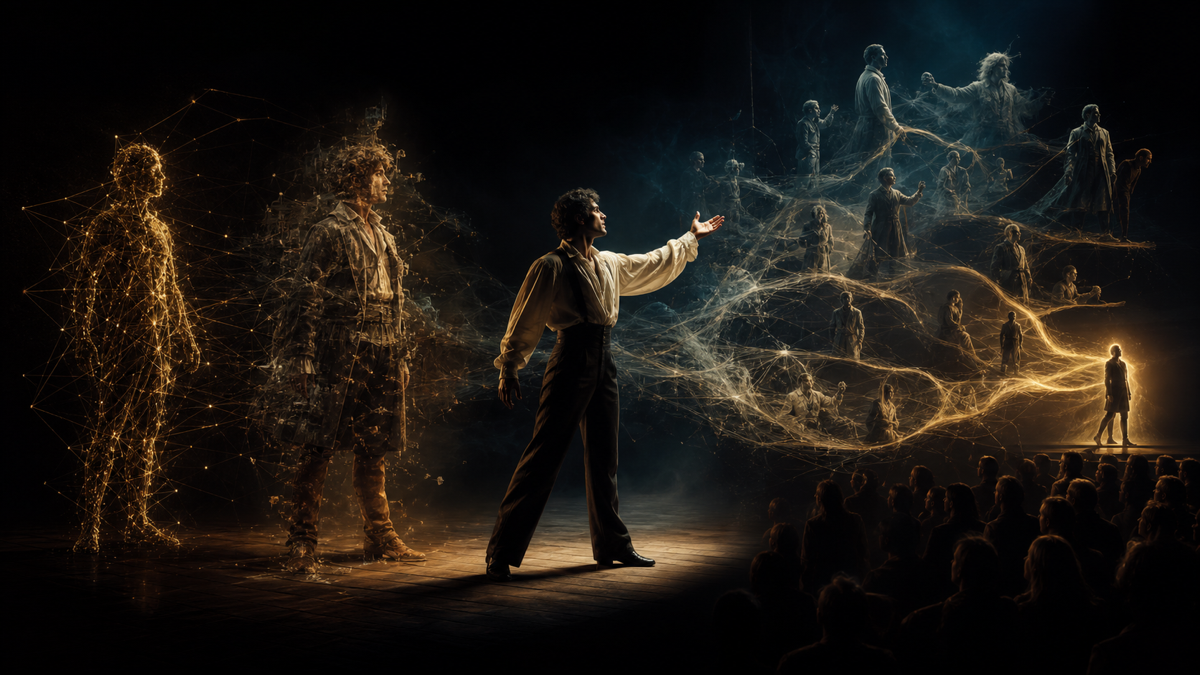
A fictional person is not exhausted by canon, and a character is not exhausted by an actor’s appearance. What an audience finally encounters is produced through several transformations: an abstract person becomes a story-specific character, an actor embodies that character, and a performance realizes one path through the possibilities available in a scene.
This distinction explains why casting can alter the cultural meaning of a character without changing a single canonical event. The actor does not merely render information that was already complete on the page. The actor changes which expressions, contradictions and transitions of the character become convincingly reachable.
Four Layers Commonly Collapsed into “Character”
1. Canonical person
The canonical person is the abstract identity that persists within the fictional world. It includes facts and relations such as:
- identity and origin;
- history and formative events;
- knowledge and beliefs;
- relationships and obligations;
- persistent traits and values; and
- changes established by the story.
This person can exist in a novel, screenplay, animation, game database or story graph before anyone performs the role. “Person” here means a person inside the fiction, not the real performer.
2. Character configuration
A character is a particular dramatic derivation of that person. It selects and emphasizes qualities for a story, adaptation, life phase, genre and point of view.
The same canonical person may appear as an impatient youth, a disillusioned exile or an experienced mentor. Those configurations remain related through identity and history, but they do not have the same active beliefs, physical condition, dramatic function or available choices.
canonical person
+ adaptation
+ life phase
+ current arc
+ dramatic function
→ character configuration
Canon supplies continuity. Configuration makes that continuity playable in a particular work.
3. Actor
The actor is the real interpretive and embodied agent who portrays the character. The actor brings a body, voice, movement vocabulary, timing, imagination, training, cultural associations and chemistry with other performers.
These are not neutral delivery mechanisms. A pause can make a line hesitant, calculating or compassionate. A posture can make authority look secure or defensive. Vocal rhythm can make idealism feel sincere, naïve, comic or dangerous.
Research on character portrayal observes measurable changes in actors’ facial behavior, gesture and prosody across roles. Scholarship on adaptation likewise treats embodiment as part of adaptation itself: the character acquires a particular body, not simply an interchangeable visual shell.
4. Performance
Performance is the realized behavior of this actor-as-character under the conditions of a specific scene. It includes speech, silence, gaze, posture, movement, timing, suppression and reaction.
A performance is therefore not a static asset. It is a path through changing states:
scene state
→ perception
→ interpretation
→ intention
→ emotion and inhibition
→ embodied action
→ audience inference
→ new scene state
The same actor may take another path in a different take. A different actor may make an entirely different region of the character’s possibilities believable.
The Reachable Performance State Space
A screenplay does not determine every glance, breath, hesitation or degree of force. It defines circumstances and actions while leaving a field of realizations open.
For a given production, the reachable performance space can be described as:
P_reachable = f(
  canonical person,
  character configuration,
  actor embodiment,
  scene state,
  direction,
  partner performances,
  medium and production constraints
)
“Reachable” does not mean physically possible. It means convincingly accessible without breaking the character, the actor’s interpretation or the audience’s accumulated expectations.
An actor may make extreme emotional openness credible while another makes restraint more powerful. One actor may support abrupt comic transitions; another may give the same character greater menace or vulnerability. Direction can extend that range, but it cannot make embodiment irrelevant.
The actor therefore both constrains and expands the character. This is productive constraint: specificity is what turns an abstract possibility into a recognisable human presence.
What If Mark Hamill Had Not Played Luke Skywalker?
Luke Skywalker’s canonical outline could remain intact under different casting. He could still grow up on Tatooine, meet Obi-Wan Kenobi, confront Darth Vader and face the truth about his father. Yet the Luke remembered by audiences would not be identical.
Mark Hamill’s youthful directness, physical commitment, vocal energy and ability to move between impatience, vulnerability and conviction became part of how the character was received. In an official retrospective, Hamill recalled approaching his original audition without a stylized interpretation because he could not yet determine the film’s unusual tone; he played the material as real and straightforward. That choice helped make an unfamiliar world emotionally legible.
During The Empire Strikes Back, Hamill also performed scenes under unusually specific informational conditions. He knew the true revelation in the confrontation with Vader while most of the set did not. Canonical information, actor knowledge, direction and physical performance converged in one scene—but they were not the same layer.
A counterfactual actor might have made Luke more sardonic, guarded, imposing or fragile. None of those readings is implied automatically by the event list. Casting would have changed the performance space and, through repeated audience experience, the cultural attractor called “Luke Skywalker.”
Canonical continuity does not guarantee performative continuity.
This is why recasting debates are rarely only about facial similarity. Audiences are comparing an accumulated performance model: posture, rhythm, emotional accessibility, chemistry and the expected way the character moves between states.
Audience Perception Is a Fifth Layer
The performed character does not end at the camera. Audiences interpret the actor through prior roles, star persona, cultural context and their history with earlier performances.
canonical person
→ character configuration
→ actor embodiment
→ scene performance
→ audience perception
Over time, that perception can feed back into later writing and direction. A quality discovered in performance may become more prominent in sequels. A line delivery may redefine how earlier behavior is understood. The derivative begins influencing the future canon.
This feedback loop explains why a fictional person can be “more than canon” without becoming arbitrary. Canon remains the system of accepted story facts. Performance creates meaning that is experiential, relational and culturally persistent even when it cannot be reduced to a fact sheet.
Why Character Consistency Is Not Enough for Generative AI
Generative production often defines character consistency as preservation of face, costume, voice and perhaps body shape:
reference image + voice + wardrobe + prompt
→ visually consistent character
That solves recognition, not characterization.
A model can reproduce the same face while changing the character’s timing, physical confidence, emotional permeability and relationship to other people from shot to shot. It may generate a technically convincing expression that is not causally bound to what the character perceived or decided.
The test is not merely “Does this look like the same person?” It is:
- Would this character notice this event?
- What meaning would they assign to it now?
- Which reactions are available to this character configuration?
- Which expressions belong to this actor’s established embodiment?
- What are they trying to reveal or suppress?
- How does the performance change the next state of the scene?
Without those relations, generated emotion is a local visual state rather than performance.
A Production Ontology for Character Performance
A generative studio can keep the layers separate and connected:
(CanonicalPerson)-[:HAS_CONFIGURATION]->(Character)
(Character)-[:EMBODIED_BY]->(Actor)
(ActorCharacter)-[:HAS_PERFORMANCE_RANGE]->(PerformanceProfile)
(Scene)-[:STARTS_WITH]->(StoryState)
(Performance)-[:REALIZES]->(StateTransition)
(AudienceModel)-[:EXPECTS]->(PerformancePattern)
The canonical person owns identity and history. The character configuration owns the active arc and adaptation-specific interpretation. The actor profile supplies embodiment and established expressive patterns. The scene owns causal circumstances. The performance realizes one transition. Audience evidence records reception without silently rewriting canon.
This architecture connects naturally to Character Arcs as Connected World Knowledge : a performance must inherit the character’s current beliefs and relationships, not a timeless adjective list.
It also keeps the generative model bounded. As argued in World Model AI vs. Studio Architecture , the model can synthesize plausible physical and emotional transitions while the production system owns which person, character state and causal transition are currently valid.
The Model Should Render a Performance Brief
For each generated scene, the production brief should contain more than a character reference:
| Layer | Required information |
|---|---|
| Canonical person | identity, history and relationships relevant to the scene |
| Character configuration | life phase, arc state, active beliefs and dramatic function |
| Actor embodiment | voice, physicality, timing and established interpretation |
| Scene state | location, prior event, knowledge, objective and obstacle |
| Performance transition | perception, meaning, intention, suppression, action and consequence |
| Visual direction | blocking, camera, duration and continuity constraints |
The model then receives a bounded production operation: render this actor-character moving through this permitted transition. It does not have to invent the entire person, interpretation and scene causality inside one black-box call.
Preserve the Distinctions
Canon can tell us who a fictional person is. A character configuration makes that person dramatically available in a particular story. An actor makes some possibilities tangible and others less plausible. A performance realizes one embodied path. The audience turns repeated paths into the character it remembers.
Collapsing these layers produces shallow character sheets and brittle generative workflows. Preserving them creates a richer account of authorship and a more controllable production architecture.
The actor does not merely stand between canon and camera. The actor transforms the set of futures the character can convincingly inhabit.