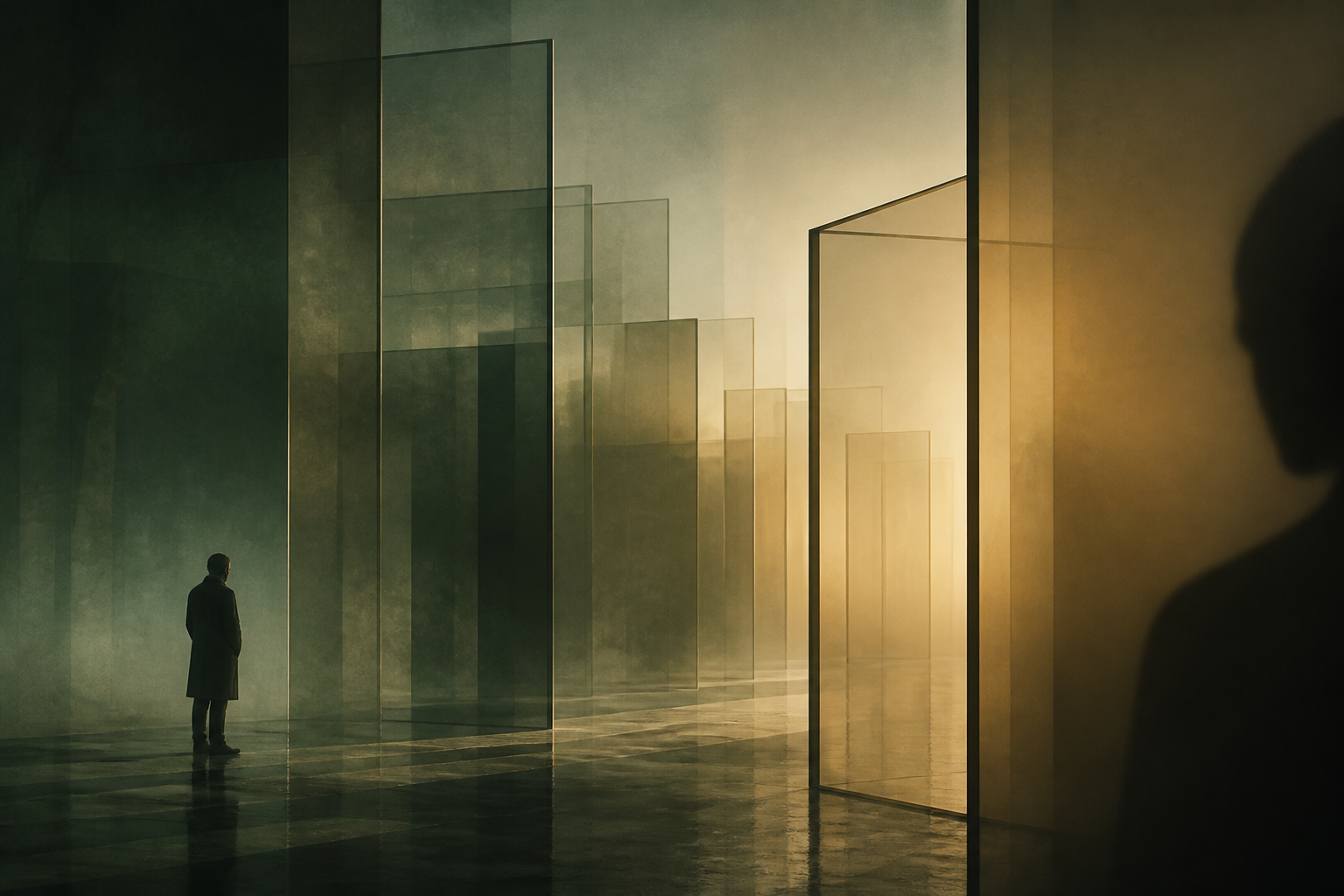
The frame creates two spaces at once: the world the audience can see and the world it must imagine. Suspense grows in the border between them.
A half-open door, an empty area behind a character, or a reaction to something outside the image can be more powerful than an explicit reveal. The camera becomes a narrator by controlling access to information—not only through what it shows, but through what it delays.
The Frame Is a Boundary of Knowledge
Composition guides attention. Centering a subject can create certainty or confrontation. Moving the subject toward one edge can create imbalance, directional tension, or room for an anticipated arrival. Negative space is therefore not simply unused space; it can become a question the image asks.
The audience reads the frame actively. If a character looks beyond its edge, viewers imagine an unseen object. If a foreground shape blocks part of a room, they wonder what is concealed. If a familiar location is shown too tightly, they sense that information has been withheld.
Four Ways to Withhold Information
Off-screen space
A sound, gaze, shadow, or reaction can point beyond the image. Off-screen space is useful when anticipation matters more than immediate confirmation. It asks the audience to construct a threat or possibility before seeing it.
Occlusion
Doors, curtains, architecture, smoke, reflections, and foreground bodies can hide part of a scene. Effective occlusion feels motivated by the location and viewpoint. An arbitrary object blocking the subject looks like a compositional accident; a doorway limiting the view feels like a person cautiously observing.
Restricted framing
A close or unusually narrow composition removes orientation. The audience may understand a detail before it knows the place, character, or consequence. The later wide shot then functions as an answer.
Misdirection
Composition can establish a clear focal point while meaningful action develops elsewhere. Misdirection should remain fair: the information exists in the frame, but hierarchy and timing influence when it is noticed.
Reveal by Changing the Frame
A reveal is not merely the appearance of new information. It is a change in the audience’s understanding. Camera position, subject movement, focus, or a cut can reorganize what the existing scene means.
Consider this sequence:
- Close view of a woman listening at a door.
- Empty corridor behind her occupies half the frame.
- Her expression changes at a sound beyond the door.
- The camera pulls back: a second open doorway behind her contains a still figure.
The empty space was not empty; it was preparation. The reveal works because the composition taught the audience where uncertainty lived.
Suspense Needs Orientation
Withholding everything creates confusion rather than suspense. The audience needs enough spatial knowledge to anticipate consequences. Establish the room, path, or relationship before restricting the view.
A useful pattern is:
- establish the ordinary space;
- introduce a visual absence or blocked area;
- direct attention elsewhere;
- return to the unresolved area;
- reveal a change.
This creates a question, lets it remain active, and provides an answer at a meaningful time.
Prompting Absence and Occlusion
AI image prompts often describe objects but neglect the informational role of empty space. Make the narrative function explicit:
Medium shot of a woman listening at a closed door on the left side of the frame, a long dim corridor occupying the negative space behind her, foreground architecture partially obscures the far end, suspense through absence, no visible threat.
For a reveal image:
Wider view of the same corridor and woman, a distant human silhouette now visible inside the previously obscured doorway, the woman has not noticed it, preserve the left-weighted composition and restrained lighting.
Generated images may add an obvious monster or dramatic face when asked for suspense. Prevent this by stating exclusions: no visible attacker, no exaggerated expression, no horror iconography, no text. Suspense can come from composition without illustrating the answer.
What to Show, When to Show It
Before composing a scene, list three things:
- What the character knows.
- What the audience knows.
- What the frame suggests but does not confirm.
When those layers differ, the camera has narrative work to do. It can align viewers with a character, give them dangerous knowledge the character lacks, or keep both parties uncertain.
The edge of the image is not where the story ends. It is where imagination begins—and where the camera can make absence feel present.