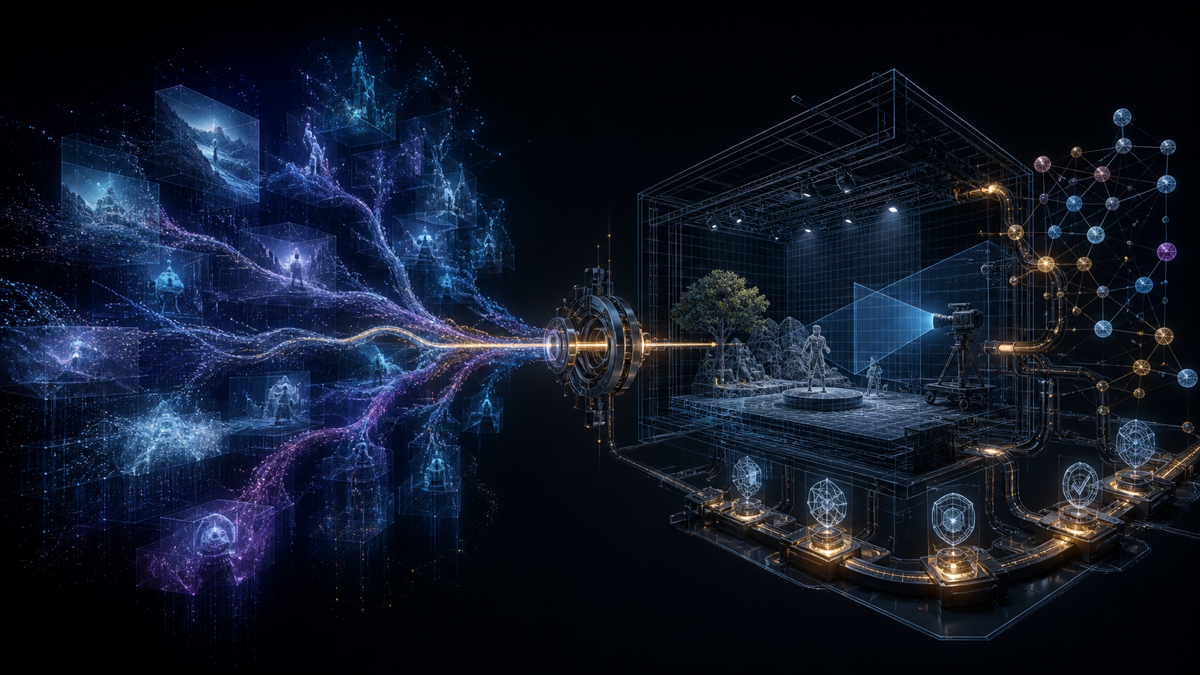
World model AI can learn how a scene may evolve, predict the consequences of candidate actions and provide useful priors about physical reality. That is a major capability. It is not, however, the same as owning an explicit production world whose entities, history, geometry, permissions and accepted state can be queried and controlled.
The distinction matters for generative media, robotics and agentic systems. A learned world model can propose plausible futures. A production architecture must decide which future is permitted, what it means and whether it becomes true.
What a World Model Actually Models
A world model learns regularities across observations and actions. Given a current representation and possibly an action, it estimates a likely future representation:
observation + candidate action
→ learned latent dynamics
→ predicted future representation
Meta’s V-JEPA 2 illustrates this approach. Its encoder turns video into embeddings; its predictor estimates future embeddings. For robot control, candidate actions can be evaluated by how closely their predicted state approaches a visual goal. Predicting in representation space avoids spending capacity on every pixel and can capture regularities useful for understanding, anticipation and planning.
This is an important improvement over treating generation as unconstrained frame continuation. But the model still produces an estimate inside a learned representation. Its internal prediction process remains probabilistic, and its useful concepts are not automatically exposed as stable production objects with identities, schemas and transaction histories.
A world model is a model of how worlds may behave, not necessarily a model of what is true in your world.
The distinction is not a criticism of JEPA’s research objective. It identifies the boundary between general predictive intelligence and production control.
The Black Box Is the Creation Process
Calling a model a production black box does not mean it has no API, documentation or controls. Inputs, outputs and supported operations may be documented exceptionally well. The black box is the creation process inside the model:
current context + goal + controls
→ [learned internal representation and prediction]
→ candidate state or generated asset
An API can expose goal images, prompts, masks or actions without making the intermediate causal structure addressable. The system may observe the result, but it cannot necessarily inspect or edit the precise internal decision by which one future was preferred over another.
This resembles the limitation of an LLM coordinator. Tool logs show what happened, yet the policy that decomposed a task and selected the next step may remain latent in a model run. Better models can make the local result more convincing while moving more production decisions into the same opaque operation.
Geometry Is Not Semantics
Explicit 3D reconstruction solves a different problem. Point clouds represent sampled geometry; meshes add surfaces and topology; Gaussian splats encode position, shape, opacity and appearance for view synthesis. These representations can preserve camera relations, depth, occlusion and spatial continuity far more directly than a prose prompt.
But geometry alone does not supply semantic identity. A cluster of points can have the shape of a chair without encoding that this is Chair 17, that it belongs to a particular character, that it was moved during Scene 4 or that another character does not know it moved.
Computer-vision systems therefore add classification, instance detection or semantic segmentation as separate inference tasks. Even a semantic label such as chair remains much weaker than production meaning:
geometry: coordinates, surfaces, camera and visibility
semantic label: chair
world state: Chair 17 is damaged and currently in Room B
narrative state: Mara believes Chair 17 is still in Room A
production rule: preserve the damage in every subsequent shot
A visually complete reconstruction can therefore be semantically incomplete. Conversely, a knowledge graph can encode rich relations while lacking the geometry required to render a consistent camera move. Neither representation should be asked to impersonate the other.
The Studio Architecture Alternative
A hybrid studio architecture treats the world model as one powerful component rather than the sole owner of the world. It separates five concerns:
| Layer | What it owns |
|---|---|
| World model or generative model | Physical priors, candidate futures and visual synthesis |
| 3D scene system | Geometry, cameras, scale, occlusion and spatial continuity |
| Knowledge and state graph | Entity identity, relations, history, permissions and current truth |
| Coordinator or execution graph | Legal transitions, order, budgets, approvals and completion |
| Validators | Geometric, semantic, policy and quality acceptance checks |
The resulting flow is not simply prompt → world model → scene. It is closer to:
explicit accepted world state
→ coordinator selects a permitted transition
→ graph resolves entities, history and constraints
→ 3D system supplies spatial state and cameras
→ world/generative model proposes or renders the transition
→ validators compare the result with the specification
→ coordinator accepts, rejects or revises the state change
The model can still perform the task at which it excels: infer motion, fill visual detail, synthesize a performance or rank possible actions. The studio owns what the task means and what survives the call.
World Model AI vs. Studio Architecture
| Question | World-model-led system | Hybrid studio architecture |
|---|---|---|
| Where do dynamics live? | Primarily in learned representations | Learned priors plus explicit transition rules |
| Where does identity live? | Often inferred from context | Stable entity IDs and graph relations |
| Where does geometry live? | Latent, reconstructed or model-specific | Addressable 3D scene representation |
| Who selects the future? | Model prediction or model-based planner | External coordinator using models as operators |
| Can one fact be edited independently? | Often requires new inference or generation | Explicit state can change without replacing every layer |
| How is acceptance explained? | Score, similarity or model outcome | Policy, evidence, validation and recorded transition |
| What happens when the model changes? | Behavior and implicit process may change together | Process and accepted world state remain system-owned |
The studio approach costs more engineering. Schemas must be designed, identities resolved, coordinate systems aligned and transitions validated. It also avoids the illusion that a sufficiently capable foundation model eliminates production architecture.
The Best Architecture Is Likely Hybrid
World models are particularly valuable where exhaustive physical rules would be uneconomical: anticipating motion, planning through unfamiliar environments, generating plausible transitions and supplying priors when observations are incomplete. Explicit systems are strongest where identity, accountability, continuity and selective editing matter.
The choice is therefore not whether to use world models or reject them. It is where to draw the acceptance boundary.
Use the world model to explore possible futures. Use the 3D scene to constrain space. Use the graph to state which world and entities are involved. Use the coordinator to preserve process sovereignty. Use validation to decide which generated transition becomes part of the production world.
This extends the broader Generative AI Production Architecture : the model may contain increasingly powerful general world priors, while the specific world, its meaning and its production history remain explicit and replaceable outside it.